

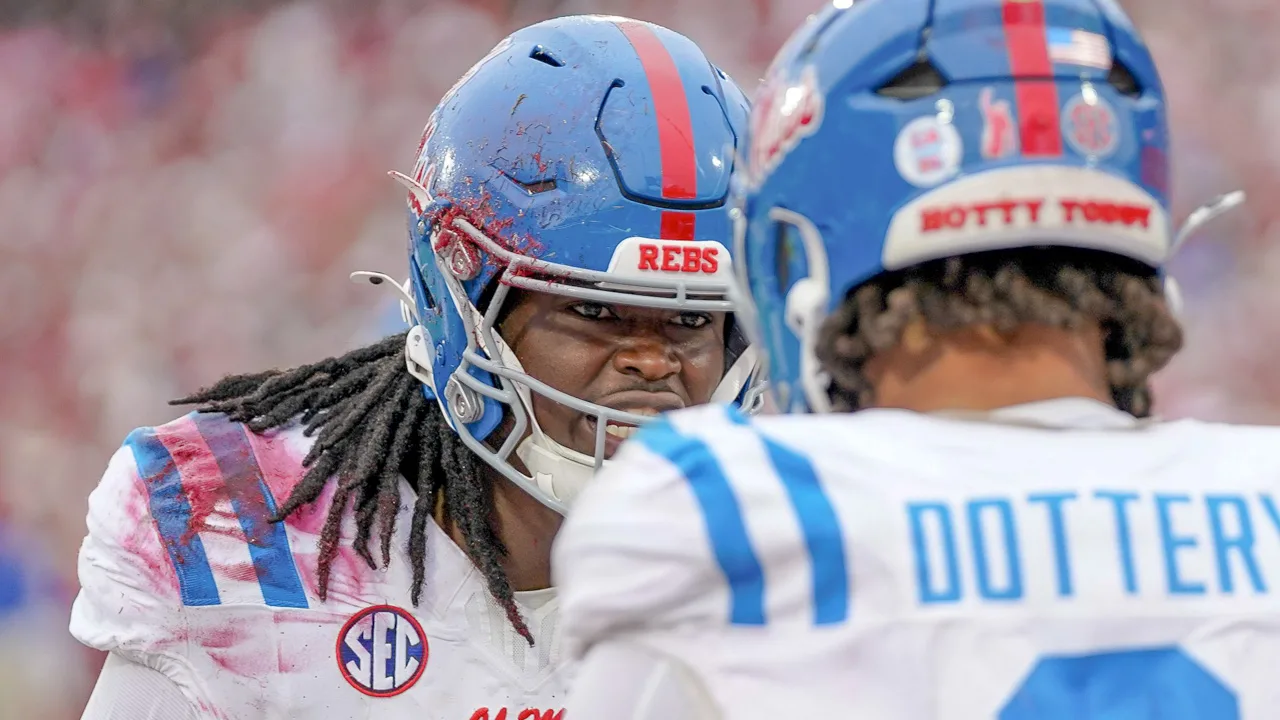
OXFORD, Miss. — There are coaches who chase championships.
Then there are coaches who chase chaos.
Ole Miss contesting Princewill Umanmielen’s portal entry isn’t about being stubborn or sentimental. It’s about finally saying no in a sport where no one ever does.
And the reason it feels necessary now has everything to do with what followed Lane Kiffin out the door.
According to reporting by Ben Garrett of the Ole Miss Spirit at On3, Umanmielen re-signed with Ole Miss earlier this month. That contract came with real numbers attached.
Any program landing him would owe more than $500,000 in buyout money, with an LSU source placing it at $590,000. The total offer is believed to be around $2 million.
That’s not a misunderstanding. That’s a challenge.
On3’s Pete Nakos reported that conversations between Ole Miss and Umanmielen are ongoing and unresolved. Ole Miss is attempting to enforce the agreement, similar to Washington’s handling of Demond Williams. That move alone signals something different: resistance.
This isn’t just a portal dispute. It’s a response.
The transfer window for new entrants closed Friday night. Schools now have 48 business hours to process requests. Umanmielen entered the portal Thursday. LSU moved quickly. Ole Miss slowed it down. That choice matters because it exposes a question college football has spent years dodging.
Do contracts mean anything, or are they just speed bumps for richer programs?
LSU’s interest isn’t surprising. What’s surprising is how openly aggressive it’s become. And it’s hard to separate that posture from Kiffin’s fingerprints.
When he left Ole Miss Rebels for the LSU Tigers before the College Football Playoff, he didn’t stick around to see how far that team could go. He didn’t try to finish what he started.
He left.
That Ole Miss roster had a real path. Instead of chasing it, Kiffin chose movement. Instability. Optionality.
Three Rebels followed him in Winnie Watkins, TJ Dottery, and Devin Harper. Watkins’ move was expected. Harper re-signed with Ole Miss before LSU paid a smaller buyout.
Dottery surprised some, though Ole Miss responded by adding Cal linebacker Luke Ferrelli, who arrived on campus after an overnight drive.
Umanmielen would be different.
This wouldn’t be depth trimming or roster reshuffling. This would be a message: contracts don’t matter if you push hard enough. Winning games becomes secondary to proving the system can’t stop you.
LSU has more than money in play. It has familiarity. Kiffin didn’t bring Pete Golding or Randall Joyner, but he did add Lou Spanos, Ole Miss’ former assistant defensive line coach and a key influence with the Umanmielen family.
That’s not accidental. That’s leverage hunting.
Winning isn’t always the goal
Ole Miss has prepared for attrition. The Rebels added EDGE help in Blake Purchase from Oregon and Jordan Renaud from Alabama. William Echoles, Kam Franklin, and Jamarious Brown are back. Suntarine Perkins functions as a regular pass rusher even while listed as a linebacker.
Still, Umanmielen matters. After transferring from Nebraska last offseason, he posted 44 tackles, 13 tackles for loss, and nine sacks.
His brother, Princely Umanmielen, starred at Ole Miss in 2024 and became a third-round NFL Draft pick of the Carolina Panthers.
Ole Miss also landed Da’Shawn Womack through the portal last year. He’s now at Auburn, reunited with former Ole Miss defensive end Wayne Dorsey. That move followed a familiar pattern.
What feels different now is intent.
Kiffin didn’t stay in Oxford long enough to chase a national title when he had a team capable of making a real run.
Instead, he left early, took pieces with him, and immediately started testing the boundaries elsewhere. That suggests winning wasn’t the only objective.
Maybe it wasn’t even the main one.
The posture LSU is taking — daring Ole Miss to enforce a contract — feels less like roster building and more like stress testing the entire structure.
Push hard enough and see what breaks. If contracts collapse, even better. That opens the door wider next time.
Ole Miss is choosing friction instead of convenience. It’s choosing to slow the machine instead of feeding it. The next 48 hours will show whether that stand holds or folds.
Either way, this moment traces back to a coach who didn’t hang around to see something through.
He left the fire burning and walked into a bigger house with more matches.
Key takeaways
- Ole Miss is testing whether NIL contracts can be enforced after the portal window closes.
- LSU’s approach looks less about winning now and more about breaking resistance.
- Lane Kiffin’s early exit from Oxford still shapes instability across rosters.