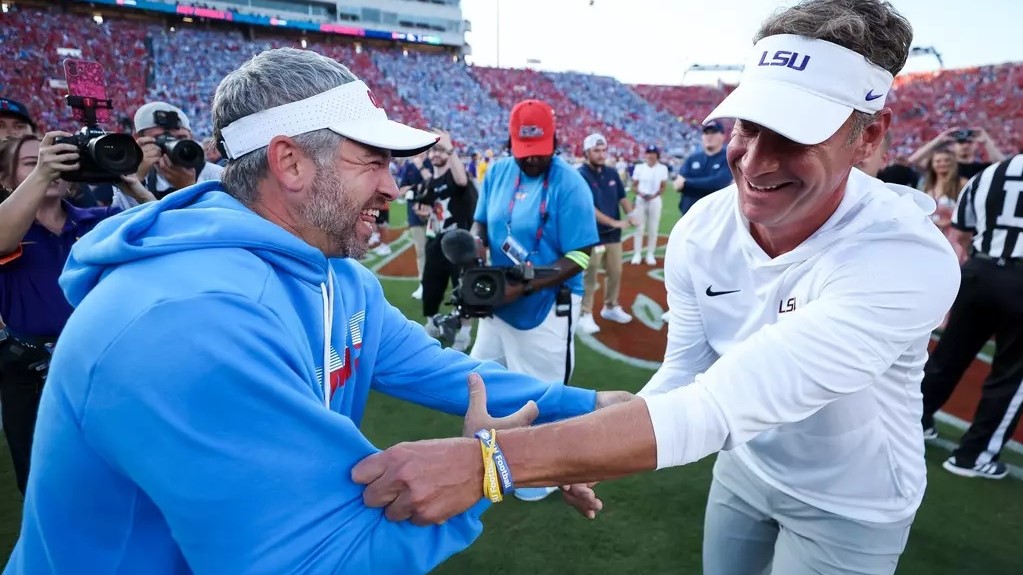
There are wins that show progress and wins that change the shape of a program. Ole Miss beating LSU on Saturday night was the second kind.
It wasn’t just a ranked win or a revenge game or a loud night in Oxford. It was the moment Pete Golding stopped being the guy who took over after the circus and became the head coach of a program that now looks and feels like his.
You could feel it in the way Ole Miss played. You could feel it in the way the sideline carried itself. And you could definitely feel it when Golding made the decision that will follow him for a long time.
Up by six with six minutes left, Ole Miss scored the go‑ahead touchdown and had a choice: kick the extra point and take the safer seven‑point lead, or go for two and try to make it an eight‑point game. Golding didn’t blink. He went for two. He trusted his offense. He trusted his team. He trusted the moment.
It worked. And it said everything.
That call wasn’t reckless. It wasn’t emotional. It was a coach who knew his team, knew the matchup and knew what kind of statement he wanted to make. You don’t go for two in that spot unless you believe your program is ready to play with that kind of edge. Golding believed it. His players believed it. And LSU had to live with it.
The players didn’t hide how much the win meant or how much Golding has meant to them.
“Yeah, I can say that. You can say that,” defensive lineman Will Echoles said when asked if this officially feels like Golding’s program. “He’s 4-1 as a head coach now, so he’s off to a pretty good start. I’m super proud of him, how he got us prepared and how the whole setup has run. With the program, he keeps us ready for any situation that’s put in front of us. I’m super thankful that he got the head coaching job. Yeah, it’s his program now.”
Quarterback Trinidad Chambliss didn’t hesitate either.
“We rally behind PG,” Chambliss said. “We know how badly he wants to win, and he puts in the time and effort. He’s up here 24/7. I was talking to him before today, and he hardly gets any sleep. He’s up here grinding, watching tape and breaking down offenses, just trying to figure out how he can put us in the best position possible to win.”
That’s not coach‑speak. That’s a locker room telling you exactly who they follow.
Golding didn’t make the night about himself, but he didn’t shy away from what the win represents. He talked about expectations, about how the standard at Ole Miss has changed, and how he walked into a program that already expected to win big.
“Since 2023, it feels like it’s a failure if you aren’t winning 10 games,” Golding said. “I remember when I was first making the move over here, it was the year after they had lost five games. I was like, ‘Man, if we can go over there and average 10 wins a year, they’ll build statues of everybody.’ Then after Year 2, it’s like, ‘Man, if we don’t go to the natty, it’s a bust.’ It feels like Tuscaloosa again.”
He wasn’t complaining. He was embracing it.
“That’s how it should be because that’s what they’ve invested into this place,” he said. “When you have elite leadership from the top and it’s vertically aligned, that’s what it should be. That’s the expectation here, and we aren’t running from that.”
Saturday night proved that. Ole Miss didn’t just beat LSU. It beat the former coach who left last December and created the emotional backdrop for everything that happened in this game. It beat a top‑10 team in a matchup everyone circled the moment Golding took the job. And it did it with a head coach who made the biggest call of the night without flinching.
That’s how you know a program belongs to someone. Not because of a press conference or a slogan or a recruiting win. Because when the moment comes, the head coach makes a decision that defines the night and everyone follows him.
Ole Miss followed Pete Golding. And now the program is his.