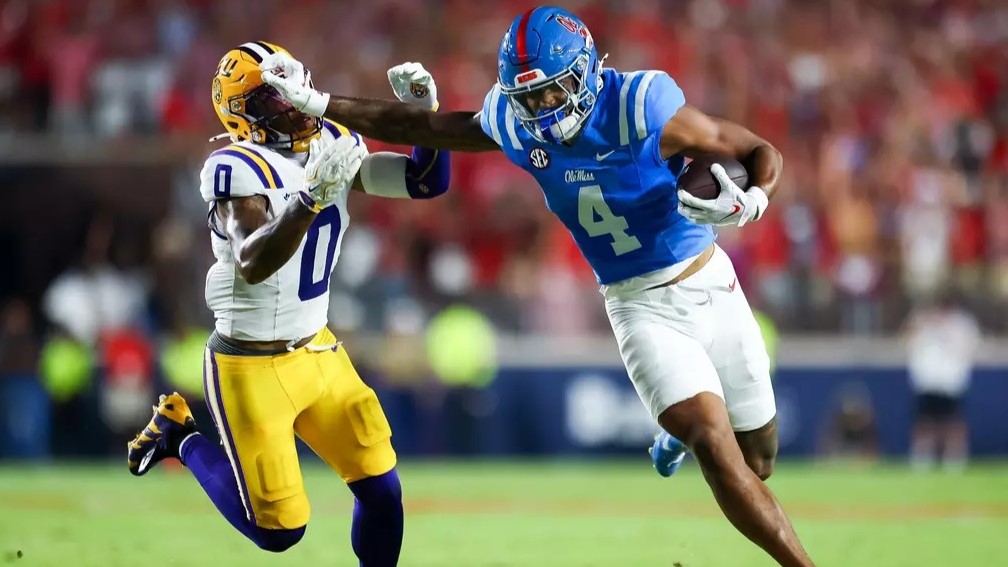
There are no shortage of candidates for why Ole Miss’ offense looked so sharp against LSU.
Trinidad Chambliss played great. The offensive line stood tall against what was a stout defensive front. The defensive secondary showed improvements, too.
Another one is how Caleb Odom has settled into his new life as a full‑time tight end, and the results are starting to show up in ways that matter.
Five catches, 88 yards, 39 yards after the catch and eight targets in a game that turned into an offensive showcase. He’s not just a big wide receiver dabbling at tight end. He’s a tight end who has become one of the more dangerous pieces in the offense.
Odom said the LSU success wasn’t some surprise. It was the product of a plan that kept unfolding as the game went on.
“We come in with a game plan every week,” he said at Tuesday’s media availability. “As an offense, and especially for me personally, I come in thinking about doing what the coaches tell me to do. But as things play out and you start putting pressure on the defense, they start getting into different coverages and doing different things, and more stuff opens up. As the game goes on, we start seeing those things. That’s why we watch film on the sideline, so we can adjust during the game.”
Those adjustments matter even more now that Odom is playing a position built on versatility. He’s not just split out wide and asked to win one‑on‑one matchups. He’s blocking, he’s lining up next to tackles, he’s moving around the formation and he’s forcing defenses to guess wrong.
And he’s glad he made the switch.
“Yeah, I’m definitely glad,” Odom said. “I think it has been something that’s been really beneficial for me. I always knew I could run routes and do that stuff, not to be cocky or anything. But putting on the weight, getting on the line of scrimmage, blocking bigger guys and understanding the technique has really helped me and made me more versatile.”
He didn’t stop there.
“Now people don’t just look at me as a big wide receiver who may or may not get open,” he said. “They can put me anywhere on the field. I can block like an offensive lineman, play tight end and do different things. It’s definitely something I love.”
The other part of this is new offensive coordinator John David Baker’s system. Ole Miss is using more two‑tight‑end formations, more motion, more chances for Odom to be a matchup problem.
It’s a system that rewards tight ends who can do more than one thing, and Odom fits that mold better than he ever has.
“I think his system is obviously maybe a little more catered to the tight ends, and maybe we get a few more looks than we did last year,” Odom said. “But I also think it goes back to what I said about really playing the tight end role. I feel like I’m way more comfortable in it now. That has allowed me to play better, play more confidently and play more efficiently, and that has led to better results.”
Those results will be tested again this week. Florida’s defense isn’t built like LSU’s. It’s faster, more aggressive and far more disruptive up front. Odom has already seen enough on film to know what’s coming.
“It’s a very unique defense,” he said. “They play a lot of one‑high and rotate a lot. Looking at the film, they have a really good linebacker corps and some guys coming off the edge. I think they’re fourth in the nation in sacks.”
That means his role doesn’t get smaller. It gets bigger.
“It’s going to be important for us to really hone in on that,” he said. “Any extra protection, chips and stuff like that, we have to be perfect with it.”
Ole Miss doesn’t need Odom to be a wide receiver pretending to be a tight end. It needs him to be exactly what he has become: a versatile, physical, confident piece of an offense that’s starting to find its rhythm. The LSU game showed what that looks like. Florida will show whether it can continue.
And if Odom keeps playing like this, the answer might come quickly.