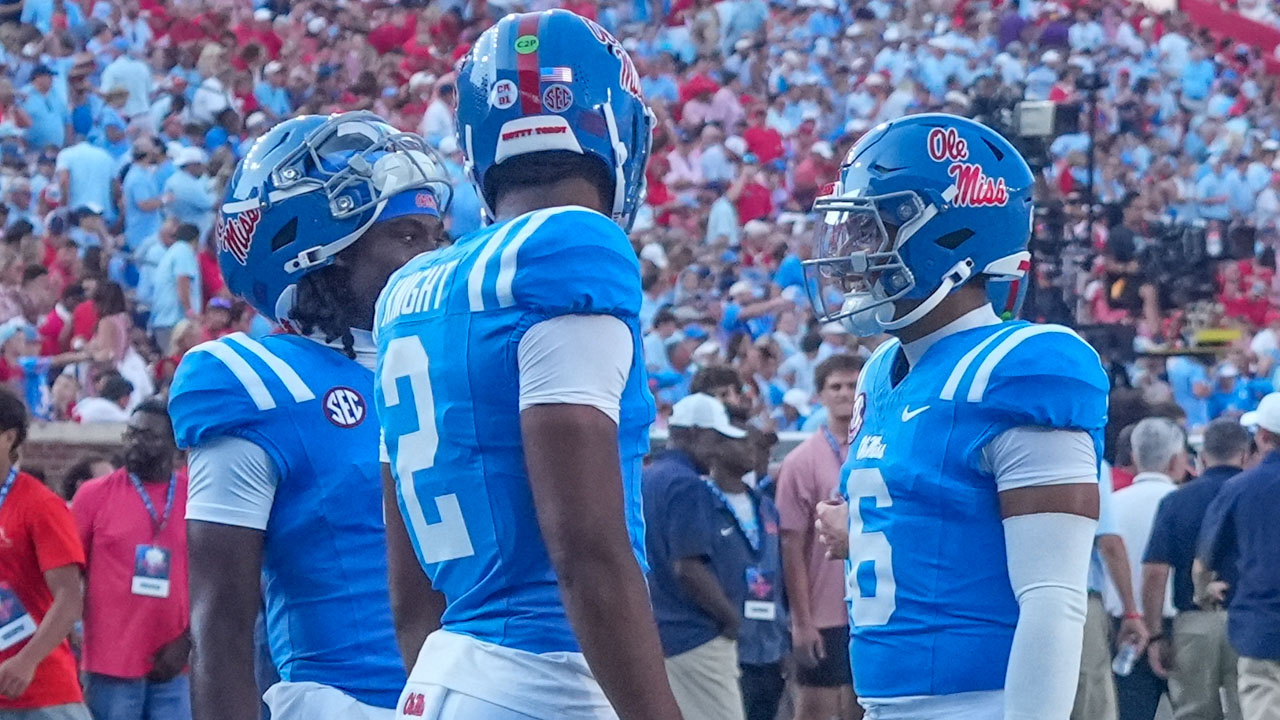
There’s no question Saturday at Ben Hill Griffin Stadium in Gainesville, Fla. is a trap game for No. 4 Ole Miss.
Fresh off an emotional, high-energy victory against LSU and former coach Lane Kiffin, the Rebels have to travel to one of the SEC’s toughest places to play. No. 21 Florida awaits with its own first-year head coach and not like a team that won only four games last season.
So, moving on from the Tigers and focusing on the Gators is the easily the question with the most impactful answer. But there are other questions whose answers will decide the outcome. Here are the three biggest.
Can Ole Miss hold Jadan Baugh under roughly five yards per carry without committing an extra defender to the box?
The Gators have a dark horse Heisman candidate in running back Jadan Baugh. He’s leading a rushing attack that’s averaging 6.0 yards per carry and he himself already has 458 rushing yards and eight touchdowns. He’s also surpassed 135 rushing yards in all three games.
The impact of Florida’s run game was on full display against Auburn. Florida ran 53 times and held possession for 39:16. The Gators weren’t merely breaking long runs; they were sustaining drives. One first-half touchdown drive lasted 16 plays and 8:19.
How does a team achieve that? By staying ahead of the sticks with runs for positive yards. The clock kept moving as the ball kept moving downfield. Against the Tigers, Baugh averaged 6.2 yards per carry.
If Baugh does that against Ole Miss, it’ll start to feel like 2024 again for the Rebels.
Can Florida’s four-man rush pressure Chambliss the way it pressured Byrum Brown?
LSU was able to pus some pressure on Chambliss last weekend. But a lot of that pressure came from stunts and blitzes. In the end, Chambliss was sacked twice and one sack directly led to an interception.
It still wasn’t enough to slow down Chambliss. More often than not, Chambliss was able to avoid the rush, escape the pocket and either make a play with his legs or make a highlight-reel throw.
That’s the problem for Florida. It could do what LSU did and run a bunch of blitzes and hope its’ enough. But the best way to slow down Chambliss and the Ole Miss offense is generating pressure with just your front four. That leaves seven defenders in coverage, so that even if Chambliss escapes the pressure, he has nowhere to go with the ball.
How much does Lacy play, and how effective is he if he does?
Lacy injured his left shoulder against LSU and is uncertain for Florida as of Monday. X-rays were negative, and an MRI reportedly showed no long-term issue, but his availability Saturday remains unknown. Pete Golding already said Lacy is likely to be a game time decision.
His absence would be felt. He has 191 rushing yards and four touchdowns through three games.
That’s significant because without Lacy on the field, defenses can focus more on stopping Chambliss.
If Lacy can’t play or is limited, Ole Miss would likely lean more heavily on JT Lindsey and Makhi Frazier. Frazier has dealt with his own injuries, while Lindsey looked good in a limited role against LSU after Lacy went down with an injury.
It could also push offensive coordinator John David Baker further toward the passing game.
And against this particular defense, that isn’t necessarily a bad thing. But good things rarely happen to one-dimensional offenses.