Through three games, Florida has shown it’s not about to have another four-win season.
The Gators, ranked No. 21 in the latest AP Top 25, have played better in their first games with John Sumrall leading the way. Jadan Baugh might be a real Heisman Trophy contender and the defense isn’t giving up much on the ground.
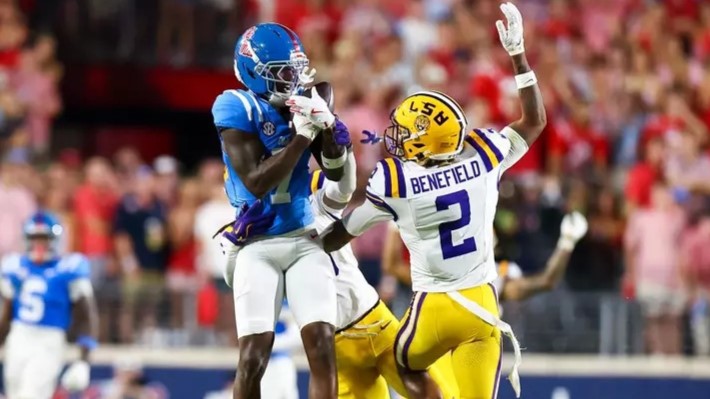
However, Ole Miss is by far the most talented team Florida will face when the Rebels head to Gainesville on Saturday. That talent may not have a bigger impact than the Rebels’ pass catchers against Florida’s defensive backs.
Florida’s secondary has been good enough to make teams work, but not good enough to erase every mistake.
The numbers look solid on paper. Opponents have completed just 59.5 percent of their passes for 695 yards, four touchdowns and three interceptions. Florida is allowing only 5.5 yards per attempt and has already piled up 11 sacks.
Ben Hanks III has been the best piece of that puzzle. He’s allowed only four catches for 23 yards on eight targets, he’s 6‑foot‑1, he’s started every game and he looks like the one corner Florida can trust in isolated coverage.
But the deeper you go, the more complicated the picture becomes.
Auburn was the first SEC offense Florida faced, and it immediately found cracks. The Tigers threw for 271 yards and hit explosive gains of 48, 35, 25 and 21 yards. Those weren’t garbage‑time freebies. They came on third‑and‑4, on back‑to‑back plays in a touchdown drive and on a fourth‑and‑13 touchdown in the final minute.
Even FAU and Campbell found explosives early in games. Florida hasn’t been easy to throw against, but it hasn’t shown it can eliminate big plays entirely.
That’s where Ole Miss becomes a problem. The Rebels don’t stress a defense in one way. They stress it in multiple ways.
Deuce Alexander is the clearest home‑run threat. He turned five catches into 159 yards against Louisville, including two touchdowns of exactly 62 yards.
LSU contained him vertically, holding him to seven catches for 60 yards and a long of 20. That sounds like a win until you look at what happened next.
Traylon Ray stepped into the void with 115 yards. Caleb Odom added 88. That’s the puzzle Florida has to solve.
Shut down Alexander and you open the door for Ray. Shade coverage toward Ray and you create space for Odom. Their explosives aren’t identical, which makes the math even harder. Alexander threatens the true vertical shot. Ray can win vertically or in that 15‑ to 30‑yard intermediate range. Odom stresses the seams and the middle of the field from a 6‑foot‑5, 245‑pound frame.
Ole Miss doesn’t need a 60‑yard bomb to flip a drive. It can hit Ray for 30 or 35, force the defense to adjust, then hit Odom for another 30. Suddenly the ball has moved 66 yards on two completions to two completely different types of receivers. That’s the kind of structural stress Florida has already shown it struggles with.
The best‑case scenario for Florida is simple to describe and hard to execute. The front four has to pressure Trinidad Chambliss without extra help. Hanks and Cormani McClain have to survive outside without constant safety assistance. And the safeties have to squeeze Odom while rotating toward whichever wide receiver alignment looks most dangerous.
The problem scenario is everything else. If Florida needs extra rushers, if the corners need more help than expected or if the safeties get stuck choosing between Alexander, Ray and Odom, John David Baker gets exactly what he wants. Chambliss identifies the matchup created by the pressure, and Ole Miss turns the stress into explosives.
That’s the puzzle. And Florida hasn’t shown it can solve all three pieces at once.