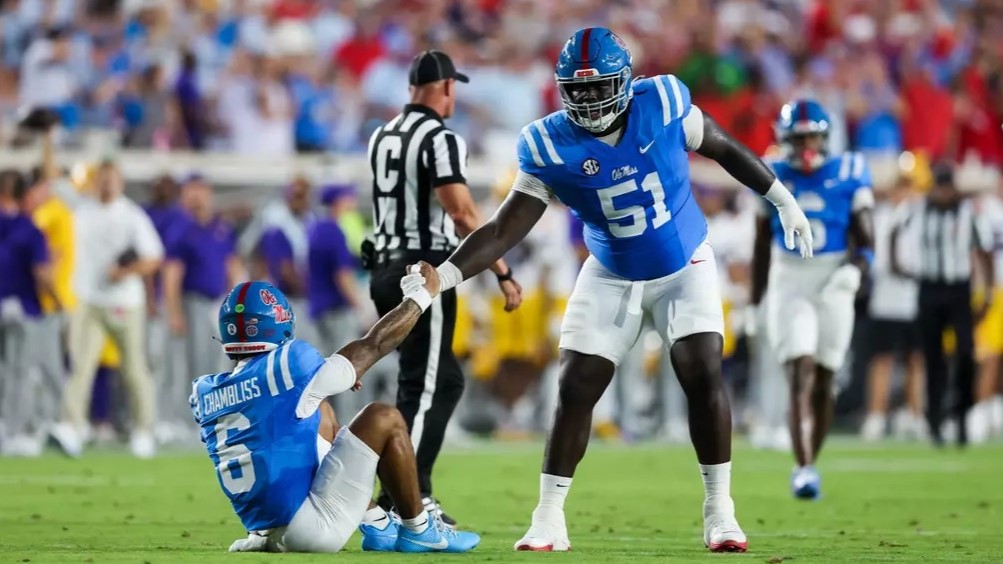
Entering the season, one of the biggest question marks about Ole Miss was its offensive line. Specifically, the two new starting tackles that joined an interior trio of returning starters.
The results, so far, have been satisfactory. The Rebels are 3-0, Trinidad Chambliss has only been sacked three times and the run game is averaging 159 yards per game and 4.1 yards per carry.
But the offensive line hasn’t played to an elite level. In fact, LSU may have exposed some cracks in the line and those cracks are something Florida could exploit.
The raw sack total makes Ole Miss look very good. Louisville didn’t sack Chambliss at all, and Ole Miss entered LSU having allowed only one sack through two games.
But Louisville is a useful example of why sacks can be misleading.
Clev Lubin entered the year coming off 8.5 sacks and 13.5 tackles for loss, while fellow Louisville edge AJ Green had four sacks in 2025. Lubin was a preseason All-ACC selection and second-team Sporting News preseason All-American.
Ole Miss kept both out of the sack column. That’s legitimately impressive.
At the same time, the protection wasn’t pristine. Chambliss’ mobility erased several potential negative plays. When Tommy Kinsler IV was injured, Connor Howes entered and reportedly surrendered only one pressure in 21 pass-block opportunities, so there were legitimate individual wins up front as well.
Charlotte, somewhat expectedly, was another solid performance. Based on Pro Football Focus grades, all but one starter had a grade above 80. But LSU was a different story. PFF had just one Rebel lineman with a grade above 80 and the lowest, Delano Townsend, was graded at 29.3 in pass blocking.
Watching the game you could see how disruptive LSU’s defensive front was. Whit Weeks, TJ Dottery and CJ Jimcoily were all officially credited with hurries at different points. Princewill Umanmielen eventually got a sack. Townsend was called for holding in pass protection.
Ole Miss did enough to win the game, but LSU was able to penetrate the protection and have an impact on Chambliss’ passes. LSU’s problem was that Chambliss is good enough to overcome miscues.
For example, Princewill Umanmielen sacked him for a two-yard loss on first down in the second quarter. Two plays later, on third-and-12, Chambliss hit Traylon Ray for a 21-yard touchdown.
Chambliss’ touchdown doesn’t erase the sack from the box score, though, and the Gators will bring another talented defensive line to face the Rebels.
Florida’s defensive line brings positional flexibility with an unusual size and speed combination that won’t just test the Rebels’ strength. It’ll test their communication and recognition, too.
The Gators want to create uncertainty about who is blocking whom. If six players are lined up to blitz, how does the Ole Miss offensive line handle its blocking responsibilities? Is everyone accounted for or is there a free rusher?
That’ll be the test this week for Ole Miss.
If there’s any silver lining, it’s that Florida’s pass rush really didn’t exist until last week. Seven of the Gators’ 11 sacks this season came against the Tigers. Against Florida Atlantic and Campbell, the Gators had four sacks and only a handful of pressures.
It’s entirely possible Auburn represented the front figuring things out. But it’s also possible seven sacks is an outlier.
There are reasons for Ole Miss to feel good about Saturday, too. Terez Davis has played exceptionally well. The Rebels already kept Lubin and Green sackless. They faced LSU’s much more highly recruited front and still threw for 363 yards. Chambliss is unusually good at turning imperfect protection into productive offense.
However, all it takes is one play to change an entire game. Florida will try to do that. Ole Miss must protect against it.