If college football is still the Wild West when it comes to NIL deals and building rosters, high noon is coming up soon.
In less than two months, the NCAA transfer portal will open, signaling the start of a shark-like feeding frenzy. We’re already hearing rumors, reports and announcements about players planning to enter the portal or stay at their current schools.
Missouri quarterback Austin Simmons is reportedly set to return to the Tigers next season. As is Mississippi State quarterback Kamario Taylor, reportedly to the tune of $7.5 million. Another quarterback, Colin Hurley, has announced his intention to enter the portal through his agent.
And that’s just what’s publicly available. You better believe there’s a whole lot more going on behind the scenes.
Not much is going to change the state of roster building before the portal opens January 4. The Protect College Sports Act isn’t likely to get passed in a lame duck Congress. And based on what happened in the midterm elections, it isn’t going to get picked back up in January.
So, those hoping for a congressional bailout at this point are dreaming a fool’s dream.
Nothing will put an end to the Wild West nature of college football except for collegiate leaders collectively bargaining with players to create a set of rules.
But those same leaders aren’t interested in doing that. That’s why there’s no sympathy or empathy from yours truly to their current plights.
However, we might see some action taken soon that could tame college football. At least a little bit.
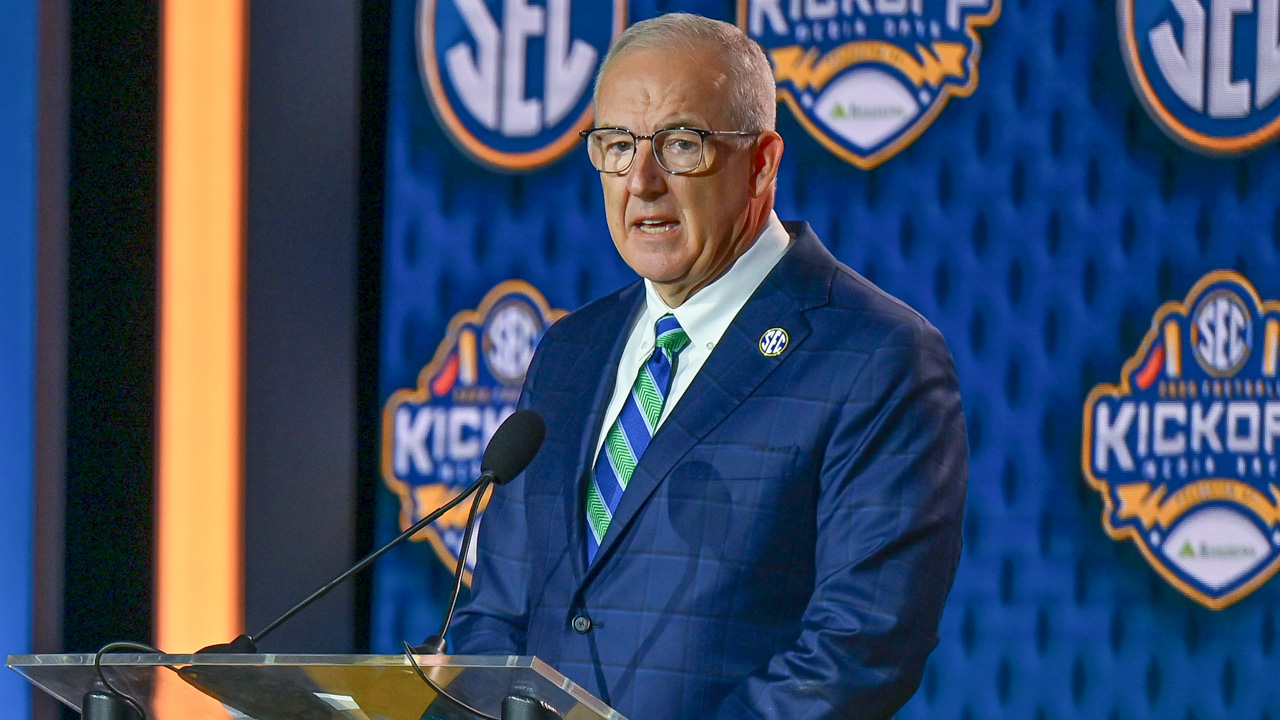
According to Yahoo! Sports’ Ross Dellenger, the SEC is working to established a cap policy that would work similar to the NBA’s luxury tax and MLB’s competitive balance tax.
“The SEC would establish a conference cap policy penalizing schools for spending over the $21.6 million House settlement revenue-share cap, with escalating fines that exceed $10 million for those spending more than $70.5 million on their rosters,” Dellenger wrote. “This means a school could spend $70.5 million on its athletes with a fine of more than $10 million as the penalties are a cumulative total of the tiers.”
Here is the SEC’s proposed cap penalty structure
(roster spend: percent fine per million)– $22.5-50.5 M: less than 1%
– $50.5-60.5 M: 1%
– $60.5-70.5 M: 3%
– $70.5M+: 10%Percent fines increase each cap year. By 2028-29, schools spending $70.5+ would owe 20% ($14M+)
— Ross Dellenger (@RossDellenger) November 11, 2026
Basically, as one power league athletic director told Dellenger, the new cap in college football (at least in the SEC) would be $70 million.
The SEC’s proposal would also remove a requirement or schools to gain the College Sports Commission’s NIL Go clearinghouse.
“This would eliminate what officials say are time-consuming and resource-draining measures to circumvent the existing cap by redirecting revenue to athletes in the form of concocted marketing and endorsement agreements,” Dellenger wrote. “Many universities are paying as much as 20% to third party entities to “wash money,” several power conference leaders contend, in an effort to effectively pass the contracts through the NIL Go clearinghouse.”
The CSC was a good idea on paper. In actuality, it hasn’t penalized a single program for cap circumvention. In a college sports world where anyone with two eyes and a brain sees cap circumvention taking place, that inaction proves CSC’s worth.
So, now we’re seeing conferences continue to exert their powers over schools to try and tame the Wild West. We saw it three months ago when teams were contemplating adding former NFL players to college rosters.
We’re seeing it now because college leaders have spent six years begging for the wrong type of congressional bailout. Instead of hoping Congress flips a switch to revert the status quo back about 10 years, they should’ve been asking for a way to collectively bargain with players.
This proposed “luxury tax” conferences like the SEC are considering and what the Big Ten has already implemented are actually good steps to take.
But let’s not confuse progress with a solution.
The schools with the deepest pockets might simply look at those penalties as another expense worth paying to build a championship roster. After all, what’s another $10 million to a program already spending $70 million on players?
And the schools without that kind of money? Well, they’ll still be trying to keep up.
At least this proposal acknowledges the reality of college football instead of pretending NIL regulations are accomplishing something they’re clearly not.
But until college sports leaders sit down with the players and collectively bargain a set of rules everyone agrees to follow, we’re going to keep having these same conversations.
There will always be another loophole to exploit, another legal challenge to navigate and another creative way to spend more money.
The SEC might finally be trying to bring some law and order to college football.
But high noon is approaching, the transfer portal is about to open and there’s still no sheriff in town.
And the people who could’ve prevented this mess are the ones who spent six years refusing to do what was necessary to fix it.