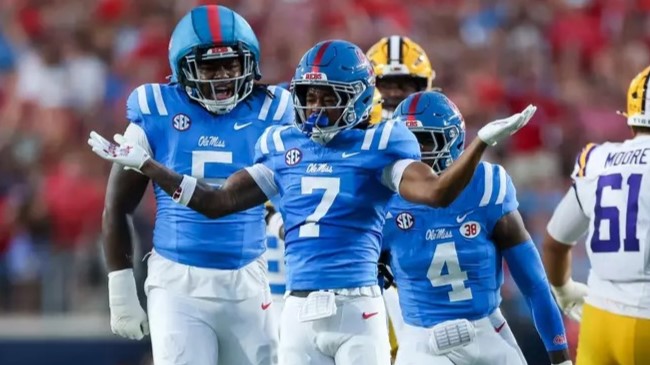
There are plenty of reasons why Ole Miss was able to liven up Lane Kiffin’s return to Oxford with a 32-24 win.
Trinidad Chambliss will get most of the headlines, rightfully so. The offensive line will get some praise after holding LSU to only two sacks. Even the defensive secondary will get some after showing big improvements from the coverage bust-filled first two games.
All of that was important and no one thing is why Ole Miss fans spent 30 minutes after Saturday’s game ended singing Garth Brooks’ Callin’ Baton Rouge and mocking LSU’s version of “Neck”.
However, if there was one thing you could point to as having the biggest impact on the game, the Rebels’ defensive line would be a good starting point.
Ole Miss defensive linemen spent plenty of time in LSU’s backfield, recording eight tackles for a loss and two sacks. But the impact goes beyond the box score.
The box score shows LSU with 172 total rushing yards, including 106 by backup Dillon Jones. However, the defensive front’s impact shows up in sacks, negative plays and how often Tigers’ quarterback Sam Leavitt was knocked off his intended passing play.
Leavitt, who was listed as doubtful in LSU’s first Student-Athlete Availability Report, had 17 carries for 63 yards and a touchdown. However, only seven of those attempts were non-designed scrambles. Add in two more sacks and eight of his carries were actual scrambles.
So, more than half of the time Leavitt ran with the ball was because he was running away from an Ole Miss lineman. Or another way to put it is that with the eight scrambles and two sacks, LSU had 37 pass-concept plays.
That’s 27% of the time Leavitt didn’t attempt to throw a pass because of pressure or because he had no open pass catchers. That explains why his final stats weren’t impressive (158 passing yards, 5.9 yards per attempt, one touchdown, one interception).
It wasn’t just the frequency of disruption Ole Miss’ defensive line had. Timing was important, too.
The Rebels opened the second quarter by forcing LSU into a three-and-out almost exclusively because of defensive pressure. Keaton Thomas hurried Leavitt on first down, Will Echoles recorded a sack on second down and then hurried Leavitt into an incompletion that forced LSU to punt.
Eleven plays, 92 yards and almost five minutes later, Ole Miss took a 17-0 lead after Traylon Ray’s touchdown catch.
The same thing happened right after halftime. Leavitt scrambled for no gain, defensive end Blake Purchase brings Leavitt down for a sack before Leavitt threw an incompletion on third down that ended the drive.
The biggest example of the Rebels’ defensive line having a major impact on the game came on LSU’s last play of the game.
The Tigers drove deep into Ole Miss territory and were trying to tie the game after Pete Golding’s gamble of a two-point conversion. But the Rebels stood tall and forced the Tigers into a fourth-and-goal situation six yards away from six points.
With a potentially open receiver behind him, Kam Franklin didn’t put too much pressure on Leavitt and tipped the pass into the air. Ole Miss’ Jaylon Braxton caught the interception to secure the Ole Miss win.
Ole Miss didn’t win because of one moment or one player or one clever call. It won because its defensive line kept showing up in the exact moments LSU needed breathing room. Every scramble, every hurried throw, every negative play chipped away at what LSU wanted to be. By the time the Tigers reached that final snap, the pattern was already set.
Franklin’s tip and Braxton’s interception will live as the highlight, but the truth is the defensive front earned that play long before it happened. They spent four quarters forcing LSU into Plan B, then Plan C, then whatever was left.
It worked and showed why LSU might’ve needed Zxavian Harris to come back to college, but Ole Miss definitely didn’t.